

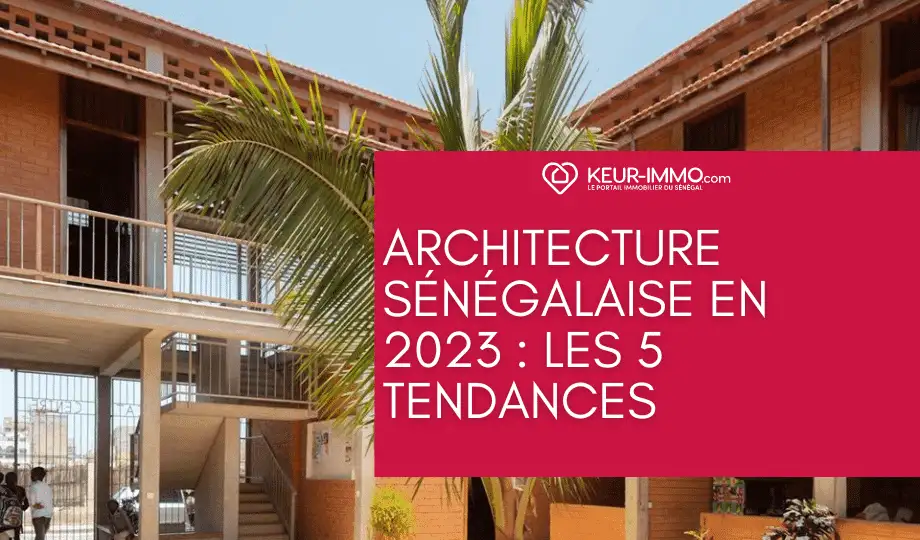

Senegalese architecture is evolving rapidly to meet the needs of the population and global trends. In 2024, several trends are emerging that could influence how buildings are designed and constructed in Senegal. In this article, we present five major trends in Senegalese architecture in 2024.
The adoption of sustainable architecture
Sustainability is a growing concern for architects and builders worldwide, and Senegal is no exception. Senegalese architects are increasingly seeking to integrate sustainable design principles into their projects to reduce the environmental impact of buildings.
The use of local and ecological materials, such as terracotta and compressed earth bricks, is preferred. These materials offer advantages in terms of thermal and acoustic insulation, while being affordable and durable over time.

Bioclimatic design is also booming. This approach involves adapting construction to the local climate to minimize energy use and ensure occupant comfort. For example, architects can take advantage of building orientation, vegetation, and solar shading elements to naturally indoor temperature.
The rise of modular and prefabricated buildings
Modular and prefabricated construction is gaining popularity in Senegal due to its advantages in terms of cost, speed, and quality. Modular buildings are designed using prefabricated modules manufactured in a factory, which are then assembled on-site.
This approach reduces construction time and improves building quality , as the modules are produced in a controlled environment and subject to rigorous quality controls. Furthermore, modular construction offers great design flexibility, allowing for the creation of customized and adaptable spaces.
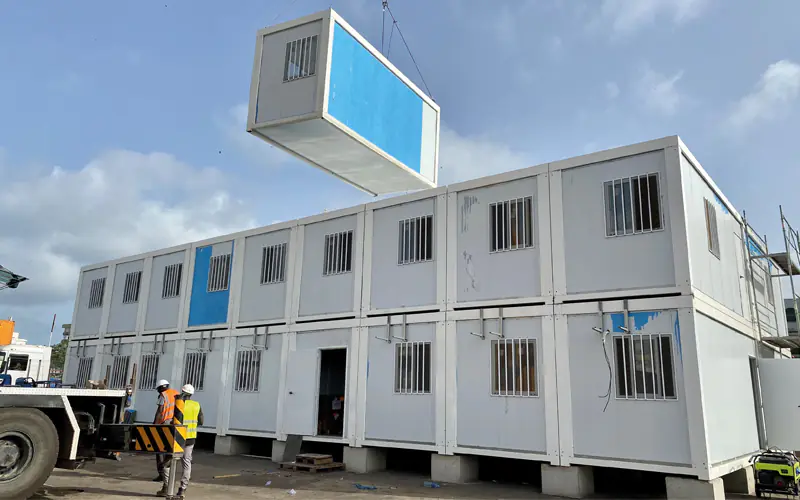
Prefabricated buildings are particularly well-suited to residential projects and public infrastructure, such as schools, health centers, and social housing.
The importance of cultural identity and local aesthetics
Senegalese architecture is experiencing a revival of interest in local traditions and ancient building techniques. Architects are seeking to create buildings that reflect Senegal's cultural identity and harmonize with the landscape.
The use of traditional design elements, such as pitched roofs , geometric patterns , and vibrant colors , helps to strengthen cultural identity and enhance the country's architectural heritage. This approach also allows for the creation of unique and aesthetically pleasing buildings that celebrate Senegal's cultural diversity and richness.

The integration of smart technologies and automation
Technology is playing an increasingly important role in Senegalese architecture, with the growing adoption of smart and automated solutions. Smart buildings use systems to control and optimize various parameters, such as lighting, air conditioning, and alarms.
These technologies bring real comfort and help reduce the costs associated with building a house and minimize its environmental impact. Senegalese architects are increasingly integrating these systems into their designs, offering clients more efficient and sustainable solutions.
Internet of Things ( IoT ) also plays a crucial role in the evolution of Senegalese architecture. Thanks to IoT, buildings can be equipped with sensors and connected devices that collect and analyze data in real time, allowing owners to take action based on this data across various criteria (energy, security, etc.).

Urbanization and densification of urban spaces
Rapid urban population growth in Senegal is placing increased pressure on infrastructure and resources. As a result, architects and urban planners are seeking to create more compact and efficient urban environments to meet the demand for housing and public spaces.
The densification of urban spaces results in the construction of multifunctional buildings , combining residential, commercial, and leisure spaces. This approach optimizes the use of space.

In 2024, Senegalese architecture is characterized by a combination of trends ranging from sustainability and the adoption of smart technologies to the promotion of local cultural identity and the densification of urban spaces. These trends reflect the challenges facing the country, such as population growth, environmental constraints, and the need to create functional and pleasant living spaces. Architects and real estate developers have a crucial role to play in addressing these challenges and shaping the future of the Senegalese urban landscape .
For real estate professionals , such as developers , it is crucial to follow these trends and integrate them into their projects. By collaborating with architects and urban planners who share this vision, they can help create sustainable, aesthetically pleasing, and functional living environments for future generations.
See all land for sale in Dakar.
In conclusion, Senegalese architecture in 2024 is characterized by exciting and innovative trends that are shaping the future of the urban landscape. By taking into account environmental, cultural, and technological challenges, real estate professionals and investors have the opportunity to contribute to a sustainable and prosperous future for Senegal. By staying at the forefront of these trends and adapting their projects accordingly, they can offer housing and urban development solutions that meet the needs and expectations of the Senegalese population.
Everything you need to know about architects in Senegal.
All real estate listings in Senegal on Keur-Immo.