

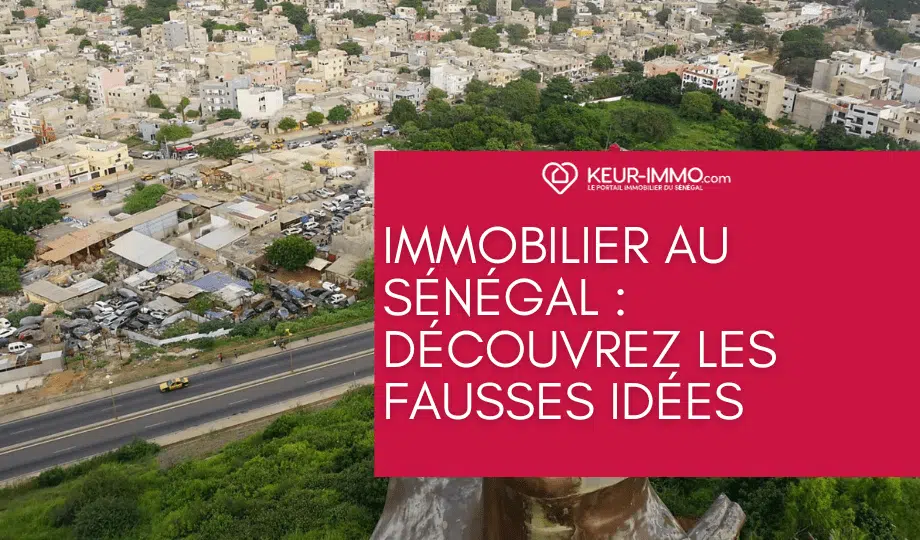


Real estate in Senegal is often shrouded in mystery and misconceptions. Many potential investors are held back by these misconceptions, preventing them from seizing very real opportunities! In this article, we will debunk some of these myths, providing insights based on facts and expert analysis to guide you toward making informed decisions.
Myth #1: The initial investment required is exorbitant.
One of the main obstacles to real estate investment in Senegal concerns the personal contribution. Many believe that a colossal sum is needed to get started. But what is the reality?
The down payment , often considered the first step towards buying property, is indeed crucial. It's the sum the buyer sets aside to supplement the mortgage amount. In Senegal, this down payment is generally equivalent to 10% of the total loan amount. However, contrary to popular belief, this down payment doesn't need to be exorbitant.
The flexibility of banks plays a key role here. If you have a solid financial profile, with regular income and a stable professional situation, such as a permanent contract or a successful business, this can work in your favor. A good profile can allow you to negotiate a smaller down payment.
Furthermore, it's essential not to put all your eggs in one basket. If a bank offers you terms that don't suit your budget, look at other institutions. Bank competition is an advantage for borrowers. By leveraging this competition, you can obtain a favorable mortgage without having to make a huge down payment.
For you: List of houses for sale in Dakar.
Myth #2: It's impossible to negotiate prices on new builds
Buying a new is often associated with the idea that it's impossible to negotiate prices, especially when dealing directly with a property developer. This widespread belief, however, is far from the truth.
Whether you're considering buying from a professional or a private seller, whether the property is new or old, negotiation is always a valuable asset. In fact, it's often the key to making substantial savings. To maximize your chances of success, it's wise to begin with thorough market research. Find out about current prices for new properties in your target area. This will provide a solid foundation for your search.
Another aspect to consider is the timing of your purchase. If you are among the first buyers in a real estate development, you are positioning yourself as a potential partner for the developer . To begin construction, developers often need to guarantee the sale of at least 50% of the units. At this stage, their flexibility is at its maximum. They may be inclined to offer more advantageous purchase conditions, such as reduced notary fees or additional amenities.
In short, contrary to the common misconception that prices are fixed, it is entirely possible, with the right strategy, to make significant savings when buying a new property in Senegal.
Myth #3: Notaries take all the fees
When it comes to notary fees , a widespread misconception is that these legal professionals pocket all the money paid. This idea is not only wrong, but it also obscures the true nature and allocation of these fees.
Notary fees, often mentioned in real estate transactions, are not limited to the notary's remuneration. In reality, these fees encompass several expenses. They cover registration fees, which record the new buyer's name in the land register. They also include land registration fees, essential for ensuring the transparency and legality of the transaction.
The notary , on the other hand, represent the actual remuneration of this professional for their services. This portion, and only this portion, constitutes the notary's income. Thus, contrary to popular belief, notaries only receive a fraction of the notary fees. The remainder is used to cover various charges and taxes related to the transaction.
Myth #4: Off-plan properties are never delivered on time
Buying off-plan, or buying in a future state of completion (VEFA) , is often met with skepticism. A common misconception is that properties purchased this way are never delivered on time. While delays can indeed occur, generalizing this notion would be inaccurate.
When purchasing a property off-plan (VEFA), developers contractually commit to respecting delivery deadlines. These deadlines are clearly stipulated in the contract, offering a guarantee for the buyer. However, as with any construction project, unforeseen circumstances can arise, leading to delays.
It is essential to note that these delays are not systematic. Furthermore, in the event of failure to meet deadlines, the off-plan sales contract (VEFA) generally stipulates penalties. These penalties, applied in favor of the buyer, can take the form of damages. Developers therefore have every incentive to honor their commitments, under penalty of financial sanctions.

Real estate investment in Senegal, as elsewhere, is rife with misconceptions and myths. These erroneous ideas, while sometimes containing a grain of truth, are often exaggerated or misinterpreted. It is therefore essential to be informed, to gather information, and to debunk these myths in order to approach the real estate sector with a clear and objective perspective.
We have debunked four of the most common misconceptions about real estate in Senegal. Whether it's the need for a huge down payment, the impossibility of negotiating the prices of new properties, the misunderstanding of notary fees, or concerns about delivery delays in off-plan sales, it is crucial to separate myth from reality.
Real estate is a dynamic sector, offering countless opportunities for those willing to venture into it with an informed perspective. By equipping yourself with knowledge, asking the right questions, and collaborating with competent professionals, you can successfully navigate the Senegalese real estate landscape.
So, the next time you hear a common misconception about real estate, take a moment to question it, research it, and understand it. You might discover that the reality is much more nuanced and favorable than you thought.
Visit Keur-Immo, the leading real estate listings website in Senegal .