



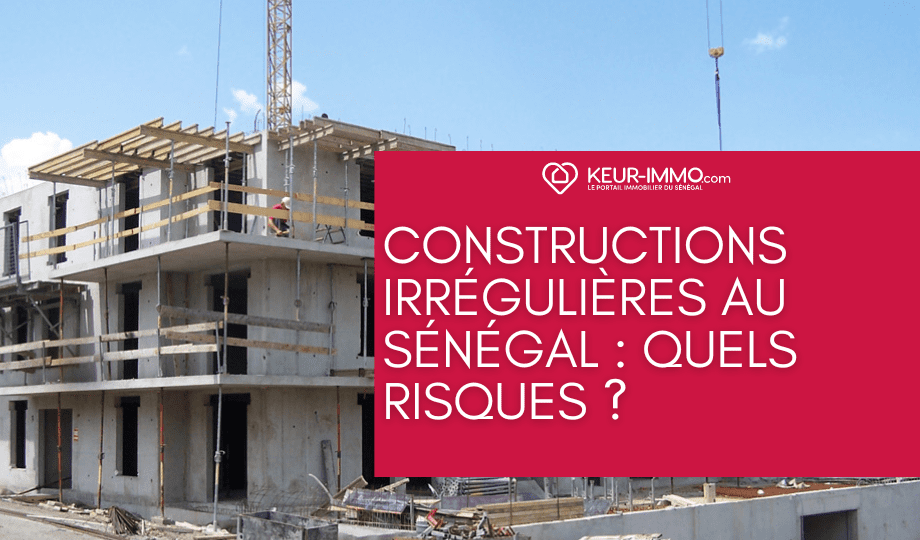
In Senegal, rapid urban development has led to an increase in irregular construction , meaning construction undertaken without the required legal authorization. Such construction is considered illegal under the Senegalese urban planning code and is subject to judicial and administrative penalties.
What constitutes an irregular construction in Senegal?
Unauthorized construction in Senegal is generally caused by various factors, such as a lack of access to information, the urgent need for housing, or the pursuit of quick profits. These constructions can vary in size and scope, ranging from simple, minor modifications without authorization to the construction of entire buildings without any permits.
Overview of legal sanctions

Legal sanctions related to illegal construction in Senegal are generally imposed after an infraction has been established by the competent body, namely the Directorate of Land Use Monitoring and Control (DSCOS) . This establishment is made through an inspection carried out by the DSCOS, which must determine whether the constructions in question have a valid permit or not.
Just for you: Our complete guide to successful house construction in Senegal .
In cases of non-compliance with regulations, legal penalties vary depending on the severity of the offense. Fines are among the most common sanctions. According to the Senegalese urban planning code, a person who undertakes or modifies a construction project without authorization can be fined between 100,000 and 10,000,000 CFA francs .
In addition to fines, prison sentences are also provided for in cases of illegal construction, particularly when carried out in an undeveloped area. In such cases, the offender can be sentenced to a prison term ranging from ten months to two years. Judges have the discretion to apply both types of sanctions simultaneously or separately, depending on the specific circumstances of the offense.
Administrative sanctions: another facet of regulation

In addition to legal penalties, illegal construction in Senegal is also subject to administrative sanctions . One of the most common administrative sanctions is the cessation of illegal construction work. When a property owner does not hold a building permit, a notice to stop work is issued by the DSCOS (Directorate of Construction and Urban Planning).
If the owner refuses to comply with this order, the competent authority is empowered to take all necessary enforcement measures to ensure the immediate cessation of work. These measures may include the seizure of materials delivered to the construction site and the demolition of structures erected on land occupied without right or title.
In the event of persistent violation of the order to stop work or of the judgment of the competent court, the DSCOS may also proceed to the demolition of constructions undertaken without authorization, in particular if the work does not exceed the level of a boundary wall or if the building does not exceed a height of 2 meters.
The DSCOS: A Central Role in Land Regulation
The DSCOS plays a central role in land regulation in Senegal. Attached to the Ministry of the Armed Forces , it is responsible for preventing and combating illegal occupation and construction. Its responsibilities include monitoring and controlling land use in urban areas and settlements, as well as verifying land use. The DSCOS also assists local authorities in monitoring illegal occupation and construction and investigates land use violations.
Informal construction in Senegal is a complex and multidimensional problem requiring a tailored and nuanced response. Through the implementation of judicial and administrative sanctions, the country strives to balance urban development needs with the necessity of maintaining order and security. The active involvement of the DSCOS in this process is essential to ensuring an orderly and sustainable urban environment in Senegal.
Looking for land for sale in Senegal? Here are all the available listings !
Visit Keur-Immo, the leading real estate listings website in Senegal .